
We developed
Infinity Skies
With DreamFuel Games.
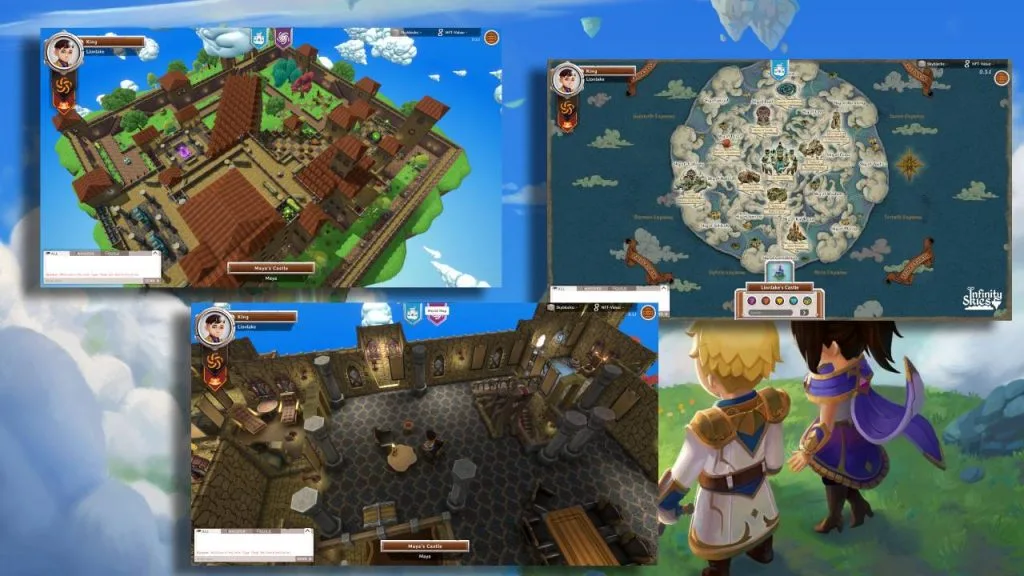
Infinity Skies is a creative multiplayer game where players build their own castles and fill them with furniture and other objects. The game uses Blockchain and Web3 technologies (Polygon) to allow players to claim islands upon which they can build their castles.
The game uses an extensive easy to use grid based building system to place walls, floors and roofs. Players can also place furniture and other objects in their castle as well as placing objects on tables, hang them on walls and adding doors and windows.
When you're done building you can explore and walk around your own castle with your character. It's also possible to visit other player's castles and to chat and interact with them.
Ecosystem Website
On the Inifinty Skies Ecosystem website, among other things, we built several dApps.
Claimpool
The Claimpool is a pool of Skyblocks (ERC 20 token) to which a small amount is paid with each transaction. Each week, as a Skyblock token holder, you can make a claim on a portion of the Claimpool. How much you get from the Claimpool is based on the portion of Skyblocks you hold in your wallet.
Plot Map & Marketplace
The Skyplots Map gives an overview of where all the lands (ERC 721) are located. You can click on a skyplot here and see more information about it, such as its Rarity, Owner, Name and location.
The Skyplots Map also allows you to trade the lands. This works just like the NFT (ERC 1155) Marketplace with a Buy and Sell Order system. With the Skyplots, we have also connected email notifications so that, for example, the owner gets an email when a new bid has been received.
NFT Marketplace
The Marketplace works on the basis of Buy and Sell Orders. This means that the user can offer an NFT (ERC 1155) for a certain price. This offer is not publicly visible. To buy an NFT, another user must put down an inquiry, specifying the maximum amount they are willing to pay for that NFT. If there is a matching offer and request then a deal is automatically made at the price in the middle of the request and offer.
In addition to an overview page of all NFTs, there is also a page where you can see all the NFTs you own and a specific page per NFT. On this specific page per NFT it displays the Meta data of the NFT and in addition to that you can place the actual Buy and Sell Orders here. Furthermore, you can also get some insights into the market value of the NFt on this page.
Staking
The Quicksilver Mines are several staking pools. The Mines are made so that they are fully adjustable in terms of staked token (ERC 20 token), duration and how much Quicksilver (ERC 20 token) the user gets as a reward for staking their token.
Store
The store dApp gives the ability to sell certain NFTs (ERC 1155) in a preset token (ERC 20). Through the smart contract it is also possible to set a stock and thus limit the supply.
NFT Conversions
The "summoning" dApp is a system where several NFTs (ERC 1155) can be converted to another NFT (ERC 1155). This system offers the option, for example, to issue vouchers that can later be converted to the real version of an NFT. Or to work as a lootbox system where you get a random NFT from a preset list of NFTs.
NFT Claiming
Dreamfuel has done several giveaways of NFTs (ERC 1155). To do this in a safe and controlled way we have created a Whitelisting system. When a user is whitelisted, they can claim an NFT. This whitelisting is directly linked to the user's Wallet Address and therefore can only be claimed by that user.
The generic design of the Whitelisting system made it trivial to deploy in other dApps. For example, it has also been used for a Bridge from Binance Smart Chain NFTs to Polygon NFTs.
Content Management System (CMS)
Accompanying the Infinity Skies Game we also built a comprehensive art pipeline CMS to streamline the workflow for the artist-heavy team at Infinity Skies. The CMS facilitated the management of concept art, 3D models, materials, lore descriptions, and more. The system was built using Angular, leveraging Google Drive and Google Sheets for back-end functionality.
The CMS was connected to the game, the API server and the NFT contracts. Centralizing the Content Management ensured that all the seperate systems were in sync with each other, while still allowing easy updating.
Backend
To support the game and ecosystem website we have created an extensive backend to be able to scale on demand.
API
Standing as the backbone for the entire Infinity Skies project with all its components is the API. The API is the central point through which User Authentication passes, the BlockChain Aggregator writes to, all the dApps communicate with, the Meta data of the NFTs come from, the saved of players' Castles are located and much more.
Game Server
In order to ensure that the Infinity Skies Game runs smoothly, we chose to build our own Game Server. It is important for the Game that the communication is reliable and that it can scale well to a large number of players in the same location. The server uses WebSockets to provide a seamless multiplayer experience, allowing players to explore, communicate and admire their creations together.
Blockchain Aggregation
To ensure that the Infinity Skies Game and Ecosystem website are fast and up-to-date, we have built an Aggregator. This listens to the blockchain and checks for updates coming in on certain contracts. When there is an update it is immediately added to the database so that the new state can be retrieved quickly.
This is used for example for the Skyblocks (ERC 20) balance, NFT (ERC 1155) inventory and Skyplots (ERC 721) inventory. But also for the various Marketplaces.


